Fleets of the Future With Smart EV Charging
Aug 29, 2023 | 8 min read
Share
The electric vehicle (EV) charging experience remains front and center for many fleet managers, according to a Ford ProTM survey of fleet decision-makers.1046 A perceived lack of convenient charging options is even holding some back from pursuing electrification in earnest.1046 In reality, public charging infrastructure is increasing every quarter.1047 And as EV charging technology gets easier to use, service and control, fleets may soon see that charging doesn’t need to be a barrier to EV adoption.
At Ford Pro, we aren’t just planning for the future of electric mobility—we’re building it. With that in mind, here are answers to six common EV charging questions.
Different EV charging stations operate at different charging speeds—or levels.
Level 1 chargers, like the Ford Mobile Power Cord, can provide power through a standard residential 120-volt AC outlet. Level 1 charging is convenient, but according to the U.S. Department of Transportation (DOT), Level 1 chargers can take 40 to 50 hours (or more) to charge an EV from zero to 80%.699 As a result, they’re not ideal for everyday commercial use.
Level 2 chargers, such as the new Series 2 AC Charging Station 80A, are recommended for overnight charging of commercial vehicles. The DOT estimates that a Level 2 charger can charge an EV from zero to 80% in about eight hours.699 Fleets typically know their schedules ahead of time, the expected miles they’ll drive on routes and the time they have available to charge. When you need vehicles road-ready each morning, scheduling overnight Level 2 charging during off-peak electric rates can deliver on productivity and costs (more on that in a minute).
Or perhaps your fleet drivers need to charge their EVs mid-day or for a second shift. In that case, direct current (DC) fast charging may be useful. Per the DOT, it takes 20 minutes to an hour for a DC fast charger to charge an EV to 80%.699 Because DC fast chargers require a 480V connection,1048 they’re unsuitable for home charging. Instead, you’ll often see DC fast chargers at public EV charging stations, but with the Ford Pro DC Fast Charger extended power options (available in 180kW and 240kW), you can bring rapid mid-shift charging to your company-owned depot.
Keep in mind that the way you charge can impact long-term battery health and performance.1049 Using DC fast charging too often can strain the battery, and ideally, you should try to keep an EV’s charge level between 20% and 80%.1049 Many fleet vehicles can complete their daily routes on one overnight charge, which is why we recommend overnight AC charging for everyday purposes.
The short answer: It depends.
Among the fleets Ford Pro surveyed that are exploring EV adoption, 80% expect to charge their commercial EVs using private charging stations at home or the workplace.1050 Ford Pro is here to help you determine where your Level 2 home charging stations should be placed and how many you need.
If you want to install charging stations on company-owned property, Ford Pro Charging will not only consult with you on the design and construction of your charging site but also work with local utility providers to align on infrastructure and power needs. It’s worth noting that DC fast chargers often require infrastructure upgrades, while AC chargers like the Series 2 AC Charging Station 80A do not. By opting for AC chargers at your depot, you can potentially avoid the need for costly upgrades.
When planning and building infrastructure, we’ll also factor in the number of EV charging stations, accessibility, convenience and weather/climate. To better serve customers in more extreme climates, we extended the operating temperature (–40 to 131 degrees Fahrenheit) and operating altitude (up to 3,500 meters above sea level) ranges of the Series 2 AC Charging Station 80A. Built-in monitors can sense, alert and automatically derate the charger in the event of overheating.
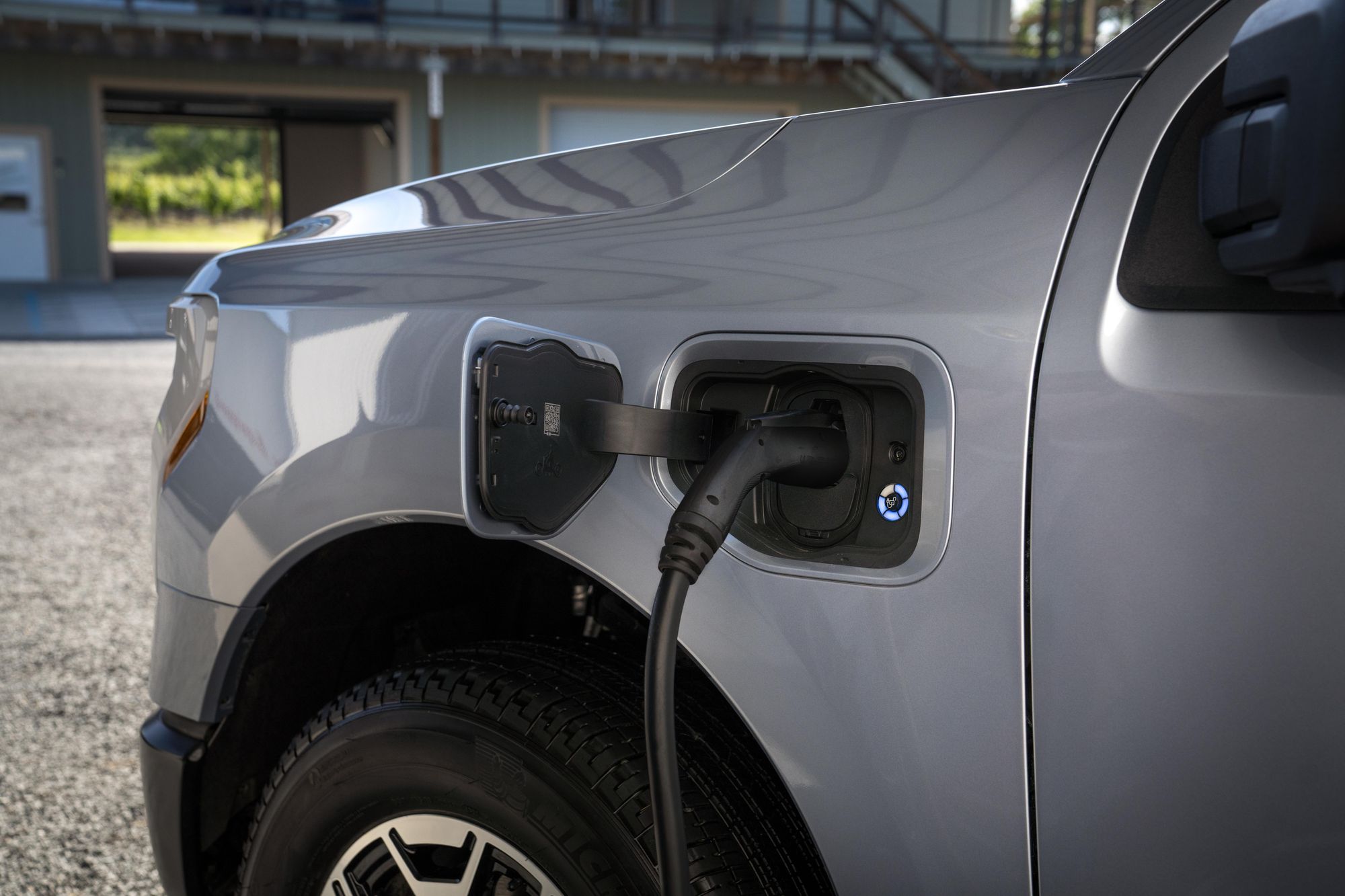
By installing EV charging stations at your company-owned depot, EV charging becomes as easy as plugging in your vehicle at the end of the workday.
The cost of EV charging depends on your local electricity prices. In California, for example, the average price of electricity is about 18 cents per kilowatt hour (kWh).1048 However, most utility providers offer special time-of-use rates, which can help reduce home EV charging costs by billing less for residential electricity used during off-peak hours.
The definition of “off peak” depends on your location, so it’s a good idea to check with your local provider. For example, in Moreno Valley, California, electricity demands peak between 4 p.m. and 9 p.m.1051 Between June 1 and Sept. 30, the cost per kWh increases to 51 cents on weekdays during that peak timeframe; however, from 9 p.m. to 8 a.m., that price drops to 31 cents because these are off-peak hours.1051 That’s why it’s a good idea to charge your EVs overnight to take advantage of lower residential rates.
Plus, when you pair EV adoption with smart EV charging software, you increase the value of your investment. Our Ford Pro Charging Software1052 can help you manage charging and its associated costs.
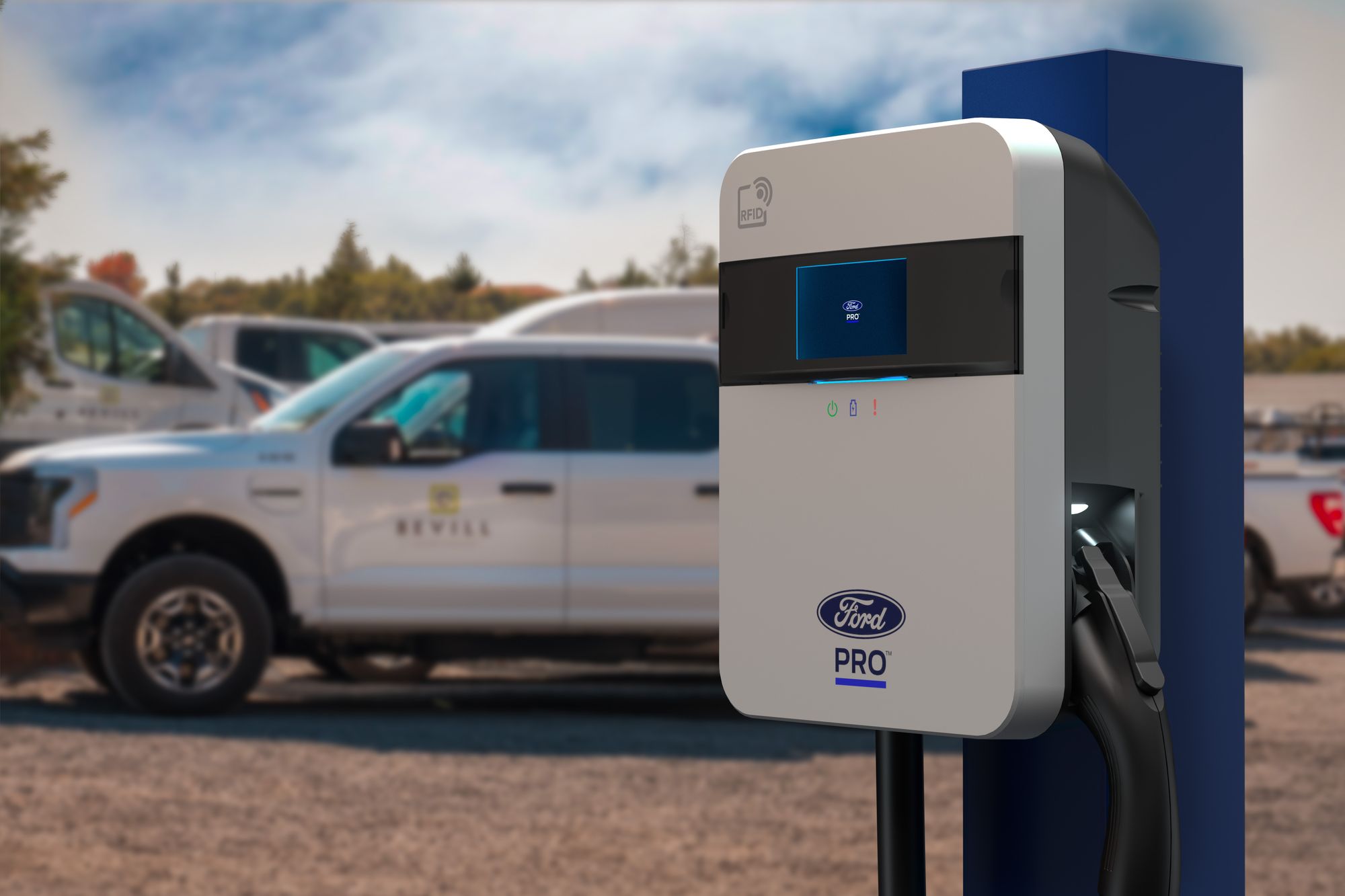
It can feel intimidating to go from gassing up your vehicle to plugging in a charger, but as more EVs hit the road, it may soon become second nature. Just under half of our U.S. survey respondents told us they’d charged an EV before.1046 When Ford Pro began designing the Series 2 AC Charging Station 80A, we aimed to improve the EV charging experience. With that in mind, we installed an LCD screen on the Series 2 AC Charging Station 80A to display step-by-step charging instructions. From this screen, you can access charge status information, energy usage and any fault alerts.
What’s more, to help prevent unauthorized charging, we’ve integrated radio-frequency identification (RFID) technology on the Series 2 AC Charging Station 80A. With RFID controls turned on, only those who tap a Ford Pro RFID Card1053 on the EV charging station’s RFID reader can start a charging session.
Better serviceability is one of the most significant improvements we’ve made. We designed the cable and connector of the Series 2 AC Charging Station 80A to be thinner, lighter and detachable, which enables fleets to repair damaged cables and connectors without having to replace the entire EV charging station. These components are the most commonly damaged part of the charger, and with this improvement, they can be replaced in less than 10 minutes. Additionally, the Series 2 AC Charging Station 80A is backed by a three-year warranty on parts and labor and comes with 24/7 tech support to help keep fleet productivity high.
As mentioned, the Ford Pro Charging Software helps fleets optimize the energy costs associated with EV charging and monitor fleetwide charging—all from a single dashboard. View daily energy usage, real-time charger alerts and more. And when paired with Ford Pro E-Telematics,129 you’ll unlock even more charging capabilities. For example, you can set up home charging reimbursement for drivers, track your progress toward sustainability goals and set up remote preconditioning to help maximize available range.
Smart charging software can also help you manage how much energy is delivered, sequence vehicle charging and place constraints based on the amount of power available at your site. Using this software can even help your fleet minimize energy costs.
The Series 2 AC Charging Station 80A also has increased connectivity via cellular data, Wi-Fi and ethernet and will automatically switch between options if one fails. Plus, its advanced powerline communication capabilities enable new features to happen over the air to improve fleet charge management, reporting and scheduling for Ford and non-Ford vehicles in your fleet.
In the transition to EVs, there’s much to consider, but there are many benefits, including tax incentives,305 brand benefits and lower operating costs.1054 Ford Pro is committed to amplifying those benefits and creating an easier, smarter EV charging experience.
"Ford ProTM Fleet Manager Global Quantitative Study: Perceptions of Electric Vehicles March 2022." This quantitative study was fielded in the United States, United Kingdom and Germany among 1,250 corporate fleet decision-makers. The survey was conducted online in December 2021. PSB was hired by Ford Pro to conduct the survey. Results are not weighted.
"Electric Vehicle Charging Infrastructure Trends." U.S. Department of Energy, Alternative Fuels Data Center. https://afdc.energy.gov/fuels/electricity_infrastructure_trends.html
“Charger Types and Speeds.” U.S. Department of Transportation.
"Electric Car Charging Overview." Drive Clean. https://driveclean.ca.gov/electric-car-charging
“Why Drive Electric?” Montgomery County, Maryland, Department of Environmental Protection. https://www.montgomerycountymd.gov/green/zev/ev-101.html
Ford Pro Charging Survey, Q1 ’23.
“Time-of-Use Rate.” City of Moreno Valley Public Works Department. https://moval.gov/mvu/time-of-use-rate.html
Ford Pro Charging software subscription and Ford Pro Telematics subscription required. Chargers must conform to Open Charge Point Protocol (OCPP) 1.6-J industry standard and be internet-connected. Ford Pro Telematics requires modem activation or plug-in modem kit purchase and activation for non-Ford electric vehicles. Ford Pro Charging software, Ford Pro Telematics and Ford Pro Data Services are subscription services subject to agreement to Ford Smart Mobility terms and conditions. Subscription subject to monthly charge. Subject to OFAC and credit check for subscription eligibility. Connected Service and features, and access to vehicle and charger data, depend on subscription and compatible cellular network availability. Evolving technology/cellular networks/vehicle and charger capability may limit functionality and prevent operation of connected features.
RFID card sold separately.
Eligible 2027 MY Ford vehicles receive a complimentary 6-month trial period and eligible 2024, 2025 and 2026 MY Ford vehicles receive a complimentary one-year trial of Ford Pro™ E-Telematics services that begins on the new vehicle warranty start date. Requires modem activation. Terms and conditions apply. Telematics service and features depend on compatible cellular network availability. Evolving technology/cellular networks/vehicle capability may limit functionality and prevent operation of connected features. Annual service contract is required for E-Telematics service after trial. Call 1-833-811-3673 or go to FordPro.com to activate E-Telematics service.
Please consult with your own tax or legal professional to determine eligibility, specific amount of incentives or rebates available. The federal tax credit is a potential future tax savings. The amount of your tax savings will depend on your individual tax circumstances. Incentives and additional rebates are not within Ford’s control. This information does not constitute tax or legal advice. For additional information, go to https://www.afdc.energy.gov/laws/409.
“Electric Vehicles for Fleets.” U.S. Department of Energy, Alternative Fuels Data Center. https://afdc.energy.gov/vehicles/electric_fleets.html