Sustainable Farming in Sonoma County
Sep 21, 2023 | 6 min read
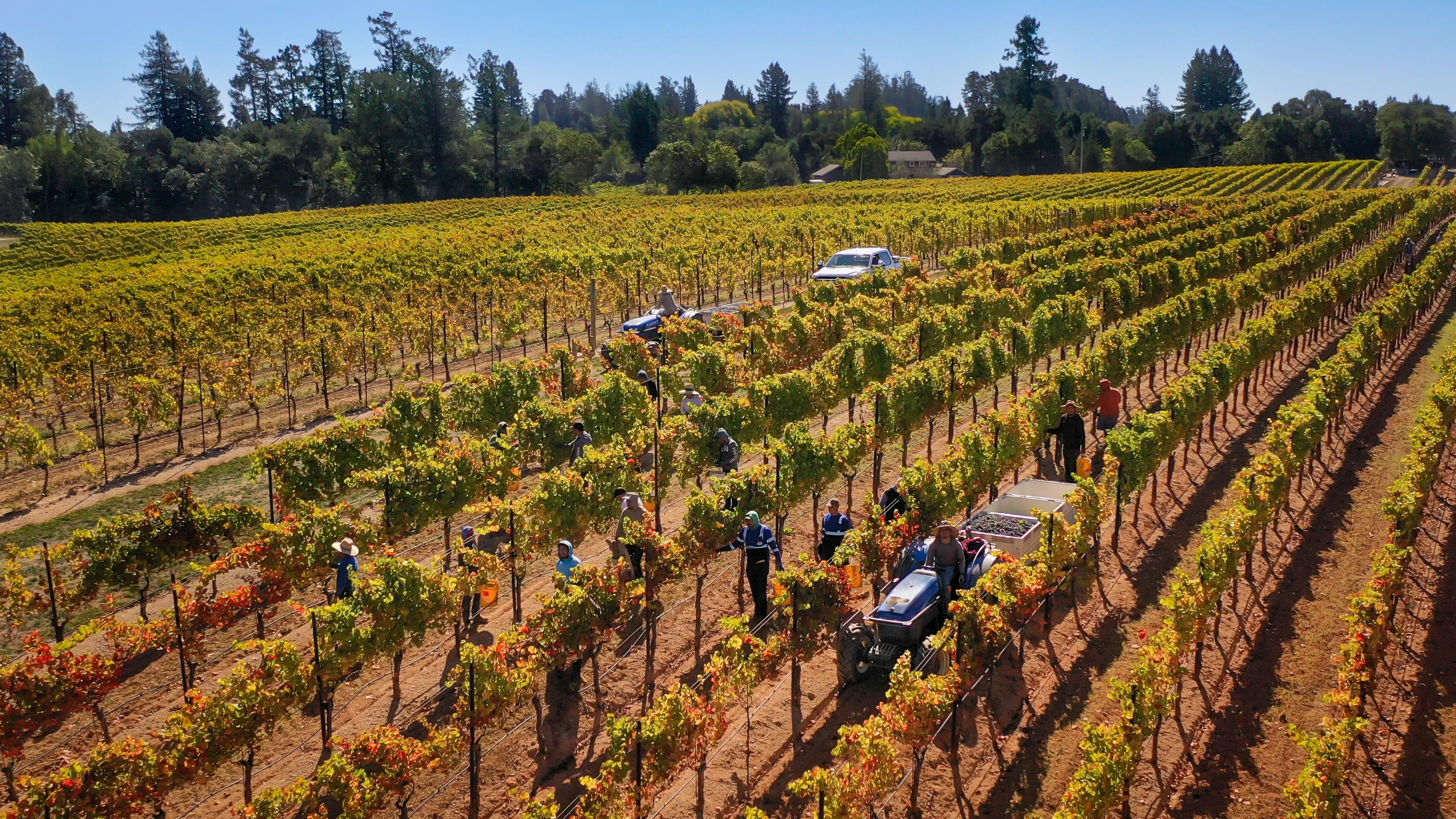
Effective business collaborations rely on many factors—but a shared commitment to goals and a foundation of trust are some of the most important. Luckily, Ford ProTM and the Sonoma County, Calif., grape growers had both from the outset.
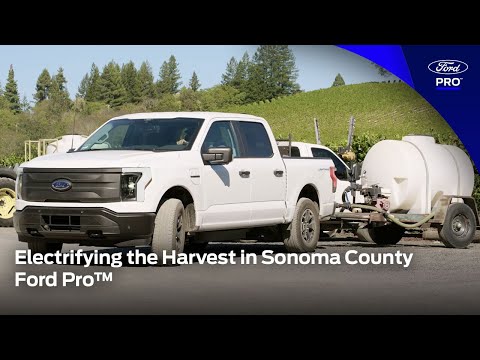
In 2022, Ford Pro launched a pilot program with the farmers to help them reduce greenhouse gas emissions, offset operating costs and increase productivity in their agricultural operations. As part of the sponsorship program, Ford Pro outfitted farmers at Bevill Vineyard Management,1033 Dutton Ranch1032 and Vino Farms1104 with all-electric vehicles, including F-150® Lightning® Pro pickup trucks and E-TransitTM cargo vans. To help promote fleet efficiency, pilot farmers also received access to Ford Pro Intelligence, including Ford Pro Telematics867 and Ford Pro E-Telematics129 , as well as depot charging.
“A Natural Next Step”
However, the Sonoma County Winegrowers were taking steps to promote sustainable farming long before the Ford Pro pilot program. In 2014, the group of 1,800-plus winegrowers in Northern California launched a sustainable farming initiative, hoping to achieve sustainable designation for virtually all of its 60,000 acres planted to wine grapes. Since then, many ranchers have installed on-site solar arrays to generate solar power.1105
“This collaboration with the Ford Pro team is a natural next step to help us continue our progress in sustainable agriculture,” said Sonoma County Winegrowers President Karissa Kruse at the time of launch.1105 The use of Ford vehicles in the past helped lay the groundwork for a fruitful collaboration. “A lot of farming families have a rich history with Ford, and with history comes trust.”1105
“Being a sixth-generation farmer, I think it’s all about continuing it to the next generation,” said Jordan Dutton of Dutton Ranch. “Collaborating with Ford Pro to take future-focused steps can only help us get there for the next generation.”
Farm Fleet Electrification
As for the vehicles themselves, the farmers adapted nicely. “It was a really exciting day when we got to go to the local Ford Dealership and see three E-Transit vans all lined up for the pilot farmers to get in and drive away,” said Kruse. “[When] the three F-150 Lightning Pro pickup trucks arrived, the farmers were just so excited.”
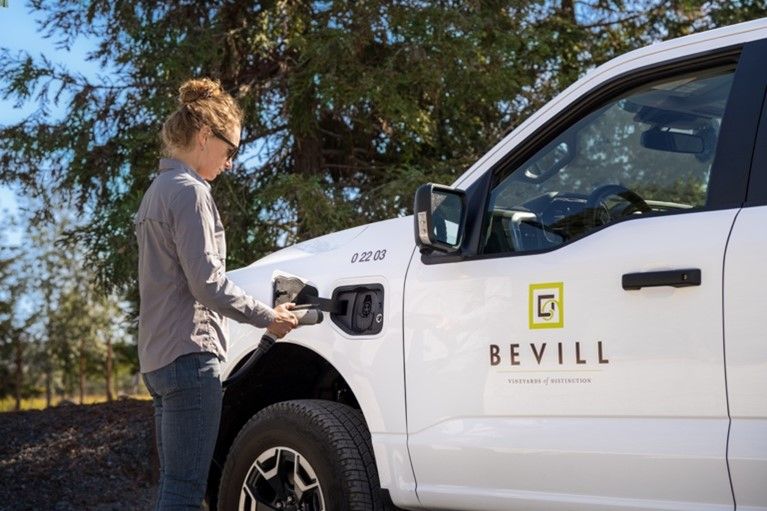
Though the pilot farmers had to get used to the EV driving experience, they are more than happy with fleet electrification.
Even still, certain differences make the EV driving experience distinct from gas-powered vehicles. For instance, EVs have relatively quiet motors.1078 The lack of noise was one of the first things Jordan Dutton noticed. “I was surprised by how quiet it was because when you get in a truck, that’s not what you expect,” she said.
Additionally, EVs use a regenerative braking system, meaning they apply braking force through electromagnetism.1106 “The brakes are something that you have to get used to, but once you do, they’re really easy to control,” said Andres Ruiz, shop manager at Bevill Vineyard Management.
Furthermore, unlike a gas-powered truck, EVs’ motors can reach maximum torque almost instantly, which results in more efficient acceleration.1107 Ruiz noted that the F-150 Lightning truck has some serious get-up-and-go—making it great for towing heavy farm equipment.
The pilot farmers are more than happy with fleet electrification. “I’ve been driving the F-150 Lightning truck, and I’ve been super impressed,” said Fabian Garcia, assistant vineyard manager at Vino Farms. “It’s fast and roomy. I’ve got the opportunity to go around the ranches and explore all the features it offers.”
Fleet Telematics and Fuel Efficiency
Perhaps one of the most exciting components of our pilot program was the opportunity it afforded winegrowers to help optimize their gas and electric fleets using Ford Pro Intelligence.
The importance of business intelligence isn’t lost on these farmers. “Data and software are how we keep everything in line and in order—whether it’s the financial aspect, the logistics of boots on the ground, payroll or even our fleet management,” said Marissa Ledbetter-Foster, VP of operations for Vino Farms. “Operating and maintaining our fleet is a huge portion of our cost of doing business.”
Fleet electrification is one way to offset monthly recurring costs like fuel. For example, at Dutton Ranch, which has about 70 vehicles in its fleet, monthly fuel costs average around $5,000.1105 As soon as Dutton Ranch received its F-150 Lightning pickup, leaders analyzed which vehicle burned the most gas and had the most miles to determine who should get the truck.
“We gave it to our parts-runner guy, and in just a few weeks, he put almost 1,000 miles on it,” said Steve Dutton, co-owner and president of Dutton Ranch. “That’s been a huge savings1108 to us because rather than burning gas, he charges the truck up every couple of days.”
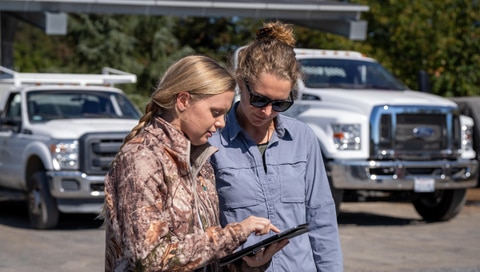
Fleet electrification can help fleets save money on recurring costs like fuel, but without the additional intelligence layer, managers miss out on important data that can help boost fleet efficiency.
However, without the additional intelligence component, winegrowers still risk overlooking costly driver behaviors and upcoming maintenance events, which can lead to unplanned downtime that can slash their bottom lines.
Ford Pro Intelligence arms the winegrowers with crucial health data on their gas- and electric-powered vehicles, allowing them to help identify maintenance events before they turn into performance problems. Moreover, the Ford Pro Telematics867 and E-Telematics129 software give farmers insight into their drivers’ behaviors and whereabouts on a near-real-time basis.
For example, Ford Pro Telematics867 tracks excessive vehicle idling in gas-powered vehicles and packages that data into an easy-to-digest Dashboard for fleet leaders to analyze. The Dashboard doesn’t just show idle time, however, it also calculates the price associated with that behavior. Armed with that information, fleet managers can use telematics data to observe and correct costly behaviors like unnecessary vehicle idling.
That’s exactly what Bevill Vineyard Management Founder Duff Bevill did when he noticed that two of his employees’ idle times were significantly higher than the rest of the team. “I know how tempting it is to sit in the vehicle on a hot day doing paperwork out in the field, but if you sit there idling for an hour, you’re obviously burning some amount of gasoline,” he said. Once he had the vehicle idling data available, Bevill worked with his employees to find ways to cut down on idle time and manage fuel costs. “Having that information, it’s just something you can manage so easily,” he said.
-fdaf6b.jpg)
The Sonoma County pilot farmers collaborated with Ford Pro in the hopes of realizing environmental and economic benefits from fleet electrification and telematics adoption. They’re proud of what we’ve accomplished together and are ready to continue making strides toward sustainable farming. “This collaboration with Ford Pro and Sonoma County Winegrowers will definitely move us as a company forward in buying and using electric vehicles,” said Ledbetter-Foster of Vino Farms.
Thinking about electrifying your fleet? Start planning your charging solutions today!
Disclosure(s)
- 1)
Bevill Vineyard Management is one of three grape growers participating in a paid sponsorship with Ford Pro.
- 2)
Dutton Ranch is one of three participating in a paid sponsorship with Ford Pro.
- 3)
Vino Farms is one of three grape growers participating in a paid sponsorship with Ford Pro.
- 4)
Available on vehicles with embedded modem or equipped with approved plug-in device (PID). May require modem activation. Ford Pro™ Telematics and Ford Pro™ Data Services require a purchased subscription. Terms and conditions apply. Telematics service and features, and access to vehicle data, depend on subscription and compatible cellular network availability. Evolving technology/cellular networks/vehicle capability may limit functionality and prevent operation of connected features.
- 5)
Eligible (2022 and 2023 MY) vehicles receive a complimentary three-year trial of Ford Pro™ E-Telematics services, and eligible (2024, 2025 and 2026 MY) vehicles receive a one-year trial that begins on the new vehicle warranty start date. Requires modem activation. Terms and conditions apply. Telematics service and features depend on compatible cellular network availability. Evolving technology/cellular networks/vehicle capability may limit functionality and prevent operation of connected features. Annual service contract is required for E-Telematics service after trial. Call 1-833-811-3673 or go to FordPro.com to activate E-Telematics service.
- 6)
"Farming of the Future: Ford Pro, Sonoma County Winegrowers Join Forces to Electrify Business of Farming." Ford Media Center. Jan. 26, 2022. https://media.ford.com/content/fordmedia/fna/us/en/news/2022/01/26/ford-pro-sonoma-county-winegrowers.html
- 7)
“All-Electric Vehicles.” U.S. Department of Energy. https://www.fueleconomy.gov/feg/evtech.shtml
- 8)
"Electric Vehicle Technology Overview – Federal Fleet Training." U.S. Department of Energy. https://www.energy.gov/femp/articles/electric-vehicle-technology-overview-federal-fleet-training
- 9)
"Drive Electric Alabama: Electric Gets You There." Drive Electric Alabama. https://driveelectric.alabama.gov/
- 10)
"Comparing Energy Costs per Mile for Electric and Gasoline-Fueled Vehicles." Idaho National Laboratory. https://avt.inl.gov/sites/default/files/pdf/fsev/costs.pdf
- 11)
Based on findings from Sonoma Farmers Pilot July–December 2022.
- 12)
Internal Survey, Sonoma Fleet Solutions Survey (April 2023).